Thermostat rules that don't start a fight with your guests
Energy costs are one of the few genuinely unpredictable line items in hosting, and the instinct to control it by locking the thermostat is completely understandable. It's also one of the most reliable ways to generate a bad review, and it's worth understanding why before doing it.
Why the hard lock backfires
A thermostat locked to a single number removes a guest's ability to respond to how their own body actually feels, at exactly the moment they're paying to be comfortable somewhere unfamiliar. Guests notice a locked thermostat immediately, and it reads as controlling rather than practical, regardless of your actual reason.
The complaint that results rarely mentions the thermostat directly. It shows up as "felt a bit cold" or "AC wasn't great" in a review, which costs you more in future bookings than the energy saving was ever worth.
A range works where a fixed point doesn't
The fix isn't removing control, it's bounding it. A smart thermostat, or even a simple stated range in your house rules, that allows adjustment within sensible limits (say, a handful of degrees either side of a comfortable default) gives guests enough agency to feel comfortable without permitting an all-night heater-versus-open-window standoff.
Set the range based on your actual climate and property, not a generic number pulled from somewhere else. A poorly insulated older building and a modern well-sealed flat have very different sensible ranges.
Say why, briefly
This single sentence does more work than any lock. "We keep it between 66 and 74 to keep the place comfortable for everyone and manage energy costs fairly, feel free to adjust within that." Compare that to a bare instruction with no context, which reads as arbitrary even when it isn't.
People generally cooperate more with a boundary they understand the reason for than one that's simply imposed. This is the same principle behind house rules that guests actually follow: a rule with a reason attached survives contact with real people far better than the same rule stated flatly.
Smart thermostats do the actual work
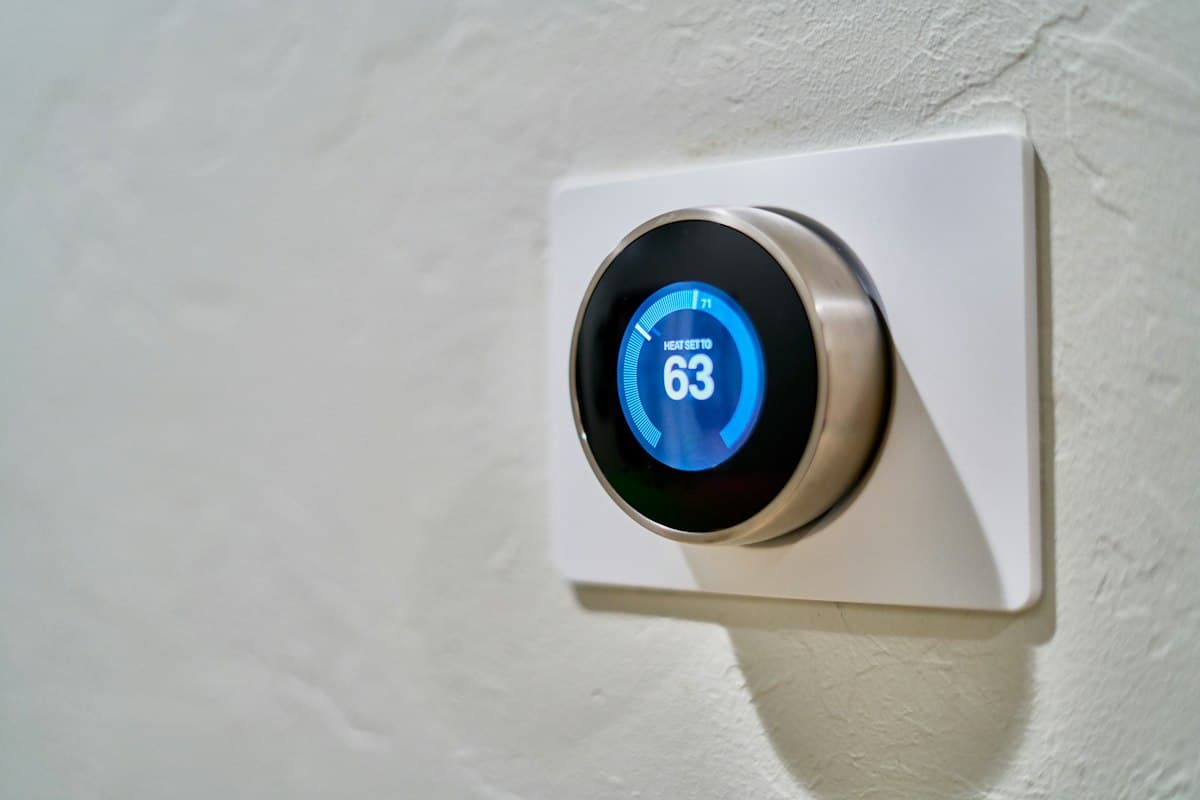
If you're hosting more than occasionally, a smart thermostat is one of the better small investments available. Set a guest-friendly range during the booking window, and an eco mode automatically when the property is unoccupied between bookings, so you're not manually adjusting anything or trusting a departing guest to do it for you.
Many models also let you set gentle limits without a hard lock, meaning a guest can nudge it within bounds but can't run it at an extreme for a week straight. This solves the actual cost problem without the guest ever feeling controlled, because from their side it just looks like a normal thermostat.
Where a hard limit is genuinely reasonable
There are real exceptions. A shared-wall or shared-system property where one unit's setting affects a neighbour, a genuine safety constraint on a specific appliance, or a documented history of guests leaving windows open with the heat running (a real waste that's worth naming specifically rather than assuming). In these cases, state the limit and the actual reason honestly, rather than a vague "for energy conservation" that reads as a cost-cutting measure at the guest's expense.
Where this fits in what you send guests
A line about the thermostat belongs in your welcome book alongside the other things a guest would otherwise have to guess at, not as an isolated rule that feels randomly singled out. Framed as one practical detail among many, rather than the one rule that got its own dramatic warning, it reads as normal information rather than a red flag.
The actual trade-off
A locked thermostat might save a modest amount on a handful of bookings and cost you noticeably more in the reviews and repeat bookings you don't get from guests who felt controlled. A sensible range, explained once, protects most of the same cost without that downside. For nearly every small host, that trade is worth making.
Common questions
- Should I lock the thermostat in my Airbnb?
- A hard lock at a single temperature usually generates more complaints and low ratings than it saves in energy costs, especially in extreme weather. A sensible range, communicated with a brief reason, is followed more often and complained about less.
- How do I stop guests running the AC or heat excessively?
- A smart thermostat with a guest-friendly range and an eco setting when the property is unoccupied does more than a rule ever will, because it removes the need to police behaviour at all. Where that is not available, a clearly stated reasonable range in the house rules and welcome book is the next best option.
- What temperature range should I set for guests?
- There is no universal number, it depends on your climate and property, but a range rather than a fixed point is the right shape: wide enough that nobody is uncomfortable, narrow enough to control costs, typically a few degrees either side of a comfortable default.
Put this into practice
The free templates and tools that cover what this article describes.
Get new host guides, when they’re worth sending
Occasional emails, only when we publish something genuinely useful. No daily digest, no spam, unsubscribe anytime.
Related reading
What to do when a guest breaks your no-smoking rule
Smoke smell is the hardest damage claim to win because it's invisible by the time you're arguing about it. Document it right and know what you can actually charge for.
Should you allow pets in your Airbnb?
Pet-friendly listings reach a less competitive market and carry real costs. Here is how to decide, and how to set it up so it works.
An Airbnb guest broke something. What now?
Most breakages are not worth claiming for, and the ones that are have a deadline. Here is how to decide which is which without damaging the review.
Setting yourself up for success as a new Airbnb host
The handful of decisions that actually determine whether hosting goes well, made before your first guest ever books, not fixed after the fact.